Direct answer
AT&T T-Mobile Verizon satellite joint venture voice failover: what buyers need to know
AT&T, T-Mobile and Verizon announced a satellite-focused joint venture agreement on October 1 and named Paul Roth interim CEO. For a VoIP buyer, the announcement does not establish that its SIP trunks, desk phones or contact-center numbers can fail over to satellite. Keep the existing continuity route until the actual contracted service, supported device and end-to-end call path pass acceptance.
This brief cites the source announcement and translates the event into a buyer framework. Verify current vendor terms before changing phone, messaging, or AI routing.
What happened
- The carriers say the venture aims to expand coverage in underserved U.S. areas and combine their capabilities with satellite providers.
- The announcement emphasizes a standards-based approach involving device makers, operating-system providers and app developers.
- Paul Roth will serve as interim CEO while a search for a permanent leader continues; each founding carrier has board representation.
- The announcement does not provide a buyer-specific acceptance result for a business SIP system. An available mobile service and a working business-number fallback are different claims.
Why this is trending
- Participation by three major carriers makes satellite coverage a broad infrastructure story rather than a single product launch.
- Businesses with remote workers, field teams and rural sites need to distinguish coverage ambition from service they can actually contract and test.
- This angle differs from recent copper retirement and 911 incident coverage: it examines acceptance of a new connectivity layer.
The VoIP Stack Index take
Consider an illustrative rural branch that has a wired broadband connection, a desk-phone service and mobile staff. Satellite availability on one handset would not automatically preserve the branch's advertised number, queue, transfers, recording or outgoing identity. Write down which business functions need continuity and ask the carrier and phone provider to prove each one. Our map is a planning aid, not a claim that the venture has delivered these capabilities.
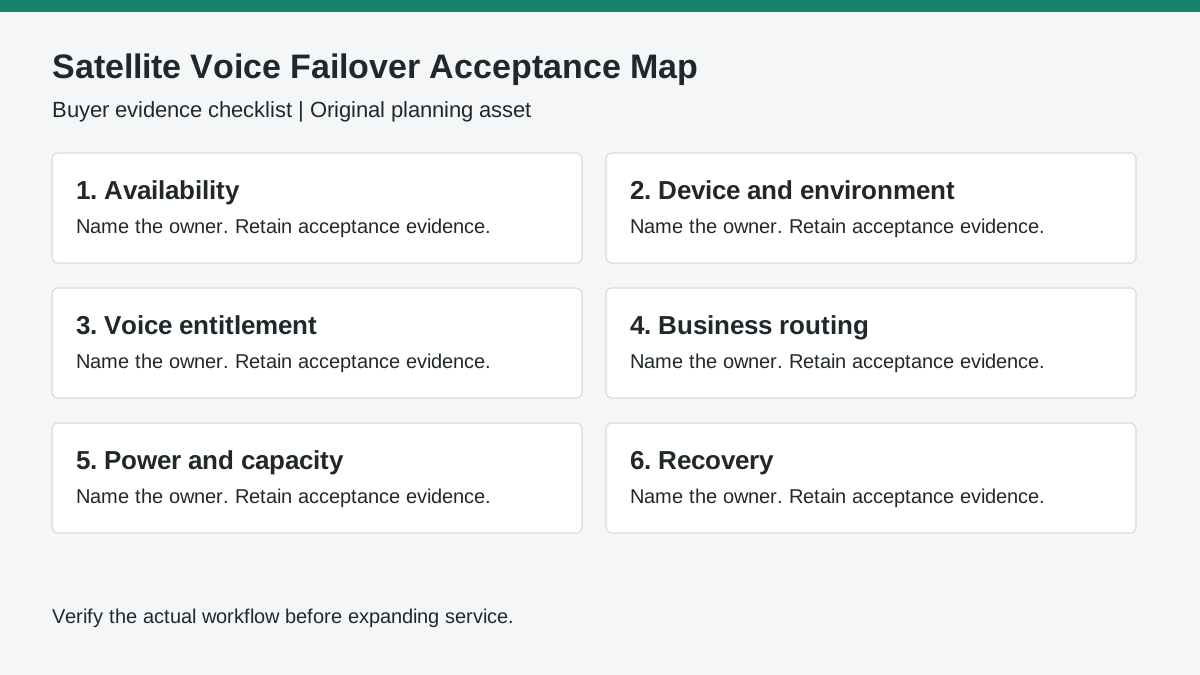
Satellite Voice Failover Acceptance Map
An original buyer map separating future coverage plans from accepted device, service, routing, power and recovery evidence.
What buyers should do next
Keep existing backup connectivity while comparing the announced venture with current contracted services.
Separate satellite messaging, cellular voice and IP data requirements.
Map business numbers and queues to the exact supported fallback path.
Use an approved non-emergency call plan to check inbound, outbound, transfer and recovery.
Record gaps explicitly rather than treating a carrier announcement as continuity signoff.
Buyer bridge
Do the routing audit before buying the buzz.
The winning AI phone stack is the one that preserves context, controls fallback, and lets humans take over without making the customer repeat the story.
Run the AI-ready VoIP audit