
Direct answer
Oklahoma 911 routing outage voice continuity proof packet: what buyers need to know
The Oklahoma 911 routing outage is a voice-continuity proof event for business-phone buyers. Local reporting said a faulty switch affected 73 of Oklahoma's 122 call centers for hours and rerouted calls to distant dispatchers. RedSky's public notice described VoIP 9-1-1 impact in the Oklahoma area and delivery to PSAP ten-digit emergency lines during the outage. Buyers should ask providers for a 911 Routing Continuity Proof Packet covering endpoint scope, registered locations, PSAP fallback, carrier escalation, affected-number discovery, user guidance and incident closure evidence.
This brief cites the source announcement and translates the event into a buyer framework. Verify current vendor terms before changing phone, messaging, or AI routing.
What happened
- KOCO reported September 24 that a 911 routing issue caused by a faulty switch disrupted emergency services across Oklahoma on Wednesday night.
- The report said the disruption affected 73 of the state's 122 call centers and rerouted calls to dispatchers in distant areas.
- KFOR coverage carried by AOL quoted Oklahoma's state 911 coordinator explaining that an AT&T switch used to route calls to the proper 911 centers failed.
- That KFOR report said the roughly seven-hour disruption did not fully stop operations because a backup plan routed calls to the appropriate ten-digit emergency lines within 911 centers.
- RedSky Technologies' public status page described a September 23-24 VoIP Positioning Center incident affecting 9-1-1 services in the Oklahoma area, with calls delivered to PSAP ten-digit 24-by-7 emergency lines during the outage.
- The Oklahoma 9-1-1 Management Authority describes its role as overseeing development and operation of emergency 9-1-1 systems and standardizing 9-1-1 administration in the state.
Why this is trending
- 911 disruptions make hidden voice-routing assumptions visible. The affected call centers, fallback routes and alternate numbers become public only after the failure path is tested by a real incident.
- The Oklahoma event was not merely a local status-page hiccup; it affected a majority of the state's call centers and required rerouting to distant dispatchers or ten-digit emergency lines.
- Business VoIP buyers rely on many of the same proof layers: registered locations, callback numbers, carrier routing, VPC behavior, SIP trunks, desk phones, softphones and branch instructions.
- Emergency-call continuity cannot be proven with a generic uptime figure. Buyers need a route-by-route record of what happens when the primary path fails.
- Recent emergency-call stories across Australia, Canada and the United States show that continuity proof is now a buyer concern, not just a carrier engineering topic.
The VoIP Stack Index take
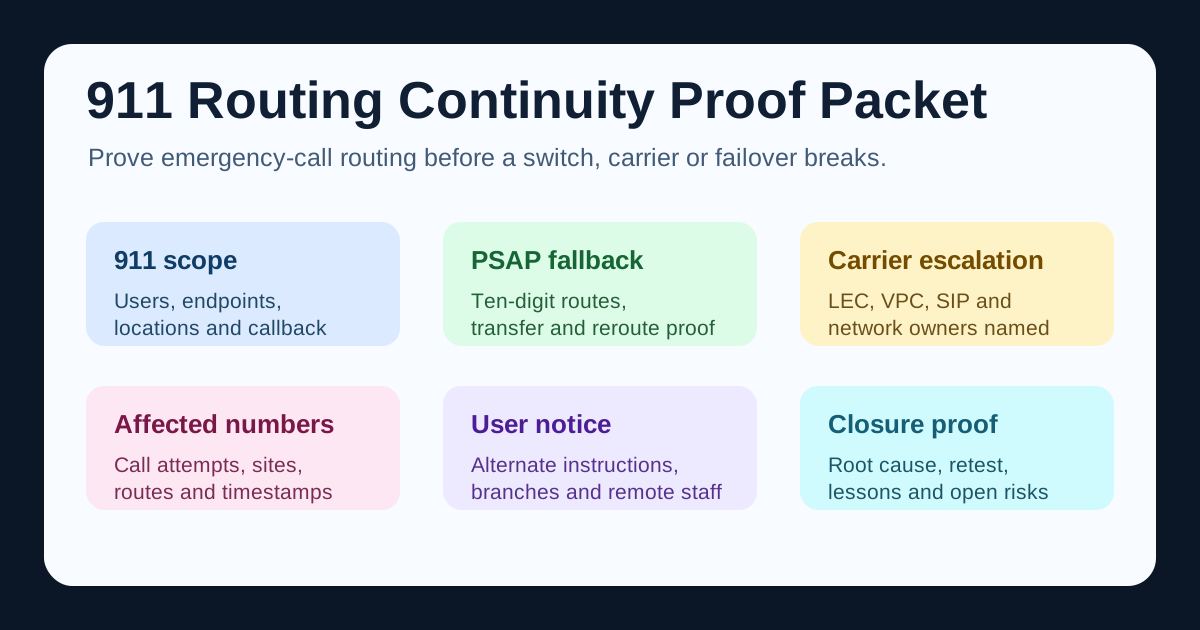
A VoIP buyer should not ask only whether 911 is supported. Ask for a 911 Routing Continuity Proof Packet that shows which users, endpoints and locations are covered, how calls are routed to the right PSAP, what ten-digit fallback exists, who escalates with each carrier or VPC, how affected calls are discovered, what users are told during an outage, and what evidence closes the incident afterward.
911 Routing Continuity Proof Packet
A VoIP buyer framework for validating emergency-call scope, PSAP fallback routes, carrier escalation, affected-number discovery, user notices, welfare handoff boundaries and post-incident closure proof.
What buyers should do next
Ask each provider to list the exact endpoints, numbers and locations covered by emergency-calling records.
Document approved fallback paths, including PSAP ten-digit emergency lines and manual transfer rules where applicable.
Name the carrier, VPC, SIP, LEC and internal owner for emergency-call routing escalation.
Define how affected emergency-call attempts are discovered, protected, reviewed and handed off to authorized parties.
Keep a closure packet with root cause, retest evidence, user notices, provider updates and open risks.
Buyer bridge
Do the routing audit before buying the buzz.
The winning AI phone stack is the one that preserves context, controls fallback, and lets humans take over without making the customer repeat the story.
Run the AI-ready VoIP audit